
PU injection grouting is a repair that pumps liquid polyurethane (PU) resin into a crack, joint or void in concrete, where it reacts with water, expands and sets to block the path the water was using. It suits active leaks, meaning water that is still dripping or seeping through right now, and it does not need your tiles or screed to be hacked off to reach them. In Singapore it is used for slab cracks, wall-to-floor joints, ceiling leaks and basements. It works best when the source has been traced first, and it is not the right fix for every leak.
Key takeaways
| Point | What it means for you |
|---|---|
| Built for active leaks | PU resin reacts with flowing water, expands and sets, so it can seal a crack that a cement patch cannot |
| Diagnosis comes first | Moisture meter readings and a visual inspection find the crack, joint or void feeding the leak before any drilling starts |
| Low disruption | Small drilled holes and injection ports (called packers), with no tile removal |
| Two kinds of resin | Hydrophobic resin foams and suits flowing water; hydrophilic resin sets as a gel and suits damp, wet conditions |
| Not a cure-all | Hollow tiles, failed screed and cracks that keep moving may still need hacking or a structural engineer’s assessment |
| Singapore setting | HDB and condo ceilings, MCST rules, monsoon seepage, landed basements and planter boxes |
What is PU injection grouting and when does it stop a leak?
PU injection grouting pumps polyurethane resin into a leaking crack, joint or void in concrete. The resin meets the water, expands and cures into a flexible seal that blocks the path. It stops active leaks, such as a dripping crack or a seeping joint, when the cause is a gap in the concrete.
Concrete cracks. Shrinkage, settlement and the daily swing between hot sun and heavy rain all leave hairline gaps, and in Singapore’s humid climate water finds them quickly. PU injection is designed for the moment when that water is actively moving through. You may also see it described as crack injection for water seepage, or listed as PU injection waterproofing. It is the same method.
PU injection grouting in plain English
Grout is a fluid filler that is pushed into a gap and then hardens. Cement grout is the kind you see between bathroom tiles. Injection grout is far thinner, so it travels into narrow cracks that a trowel could never reach.
Polyurethane (PU) is a resin that reacts with water. A cement patch needs a dry, stable surface to bond to, and a leak that is still flowing washes it out. PU resin works the other way round: it meets the flow, swells to fill the crack and cures into a flexible, rubber-like seal.
That is why PU injection is the method for active leaks when non-hacking nano waterproofing is not the right fit. Nano treats surfaces and grout lines. PU injection treats the crack itself.
What is the difference between hydrophobic and hydrophilic PU grout?
Hydrophobic PU grout repels water once cured. It reacts with water to foam and expand quickly, which suits flowing leaks. Hydrophilic PU grout absorbs water and sets as a soft, flexible gel, which suits cracks that stay damp or wet. The right choice depends on the crack, the flow and the conditions, so it is decided on site.
| Resin type | How it behaves | Usually suits | Watch out for |
|---|---|---|---|
| Hydrophobic (repels water) | Reacts with water, foams and expands fast, then cures into a seal that does not soak up water | Active, flowing leaks in cracks and joints | The resin must reach the full depth of the crack |
| Hydrophilic (absorbs water) | Mixes with water and sets as a flexible gel that swells when wet | Cracks and joints that stay damp or wet, where some movement is expected | The gel can shrink if the area dries out for long periods |
Many active leaks call for a hydrophobic resin, but the label on the drum is not the whole answer. The contractor should explain which resin they plan to use and why, based on what the diagnosis shows.
How does PU injection grouting work, step by step?
A PU injection job runs in four steps. The leak is traced with a moisture meter and visual inspection, small angled holes are drilled along the crack and injection ports fitted, resin is pumped in under pressure until the crack is filled, and the area is cleaned and tested. Tiles and screed stay in place.
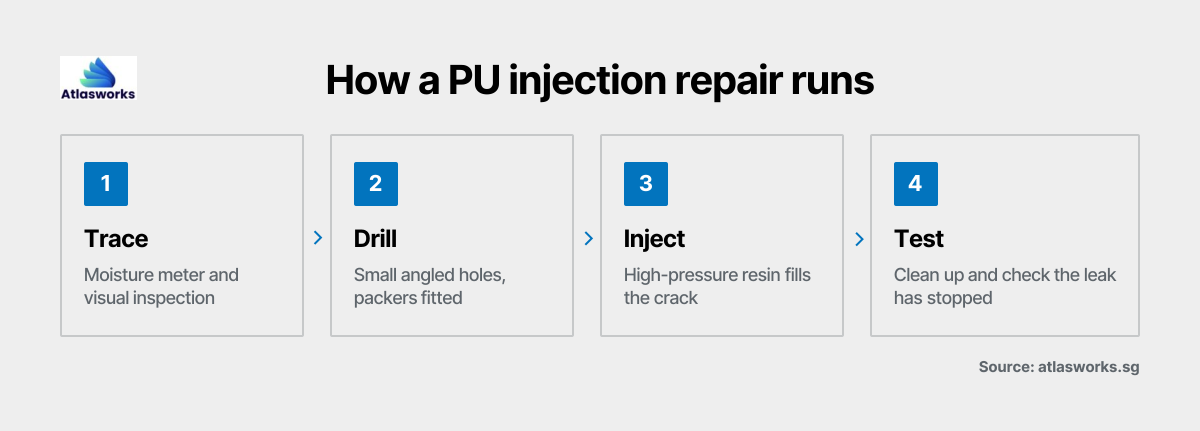
Tracing the source before drilling
Water rarely drops from the spot where it enters. A stain on a ceiling can sit some distance from the crack above, because water travels along reinforcement bars and slab edges before it surfaces.
So the job starts with moisture meters and a visual inspection. A moisture meter is an instrument that reads how much water sits inside a surface, which lets the wet zone be mapped without opening anything up. The next step is finding the crack, joint or void that feeds it, then deciding whether PU injection, nano or another method is the honest answer. Skipping this step risks sealing the wrong spot while the real entry point keeps leaking.
Drilling, packers and high-pressure injection
Once the source is confirmed, the work itself is fairly quick and contained.
- Drill. Small holes are drilled at an angle along the crack, so each hole crosses the crack deep inside the concrete rather than beside it.
- Fit packers. A packer is a small injection port that seals into each hole and gives the resin a controlled way in.
- Inject. A high-pressure pump feeds the resin through the packers, usually from the lowest port upward, until it fills the crack and shows at the surface or the next port.
- Clean up and test. The packers are removed, the area is cleaned and the leak is checked. Where the area allows it, the spot is watched for a while to confirm.
Because the holes are small, the dust is minimal and your floor finishes stay in place. That is what is meant by PU injection being done without hacking tiles or major demolition.
Curtain grouting for basements and retaining walls
Some leaks come from the soil behind a wall rather than from a single crack. For these, a method called curtain grouting injects resin from the inside, through the wall, into the ground behind it.
The resin forms a sealed zone in the soil, like a curtain hung between the earth and the wall, so water meets that barrier before it reaches the concrete. It is used on basement and retaining walls where the outside face cannot be reached. Whether it applies to your property is decided after the site survey.
What are the signs of a leak that PU injection can fix?
The usual signs are water dripping or seeping through a crack in concrete, damp patches or white deposits along a construction joint, seepage through a basement wall or slab after rain, and ceiling stains that return after every repaint. One stain does not prove a crack, so the cause should be confirmed before any method is chosen.
A few patterns point towards injection rather than a surface treatment:
- A crack that drips or weeps. Water is visibly coming through the concrete.
- Marks along a construction joint. This is where two concrete pours meet, and damp patches or white deposits often follow it.
- Seepage through a basement wall or slab. It is often worse after rain.
- Ceiling stains that keep returning. They come back after every repaint because the source above has not been sealed.
The white deposits are efflorescence, the powdery stains left when water carries salts through concrete. They tell you water is travelling through the structure, not just sitting on the surface.
Timing also helps you read the problem. In Singapore the Northeast Monsoon runs from December to March and the Southwest Monsoon from June to September, and long spells of heavy rain push more water through weak points. Seepage that stays hidden in dry weeks becomes easy to see. If your stain only appears in those months, note the dates and tell the surveyor.
Condensation, a failed sealant line or a leak from an upper unit can look identical to a crack, which is why the cause comes before the repair.
Where is PU injection grouting used in Singapore homes and buildings?
PU injection in Singapore is used wherever concrete meets water and a crack has formed: HDB and condo slabs, walls and ceilings, basements, lift pits, planter boxes, and pool and pond structures. The method is the same in each place, but access, rules and who is responsible for the repair differ.
HDB and condo slabs, walls and ceilings
Cracked slabs, wall-to-floor joints and ceilings that stain whenever the unit above is wet are the usual jobs here. For a ceiling leak, the fix often sits in the slab or joint above, which may be in your neighbour’s unit, so a conversation with them comes before any work.
Responsibility matters before you book anyone. In a condominium, common areas such as the roof and external walls are usually the MCST’s responsibility, and the management office will have by-laws on renovation works and contractor access. In an HDB flat, check HDB’s rules on the works you plan, particularly if the leak affects the unit below. Your managing agent or town council can tell you which side of the line your leak falls on. Our condo waterproofing in Singapore page covers more of the condo side.
For wider surface leaks across floors, walls and ceilings, our floor, wall and ceiling waterproofing page covers the other methods.
Basements, planter boxes and landed properties
Basements, lift pits, planter boxes, and pool and pond structures all sit against water by design, so they develop seepage at joints and cracks. Landed owners often hold the whole structure, which makes decisions simpler. Ground water pressing on a basement wall is relentless, though, and calls for a proper diagnosis.
For basement seepage, see our basement waterproofing page. If your property is a commercial one, tell the contractor about access hours and safety requirements up front, so the quotation reflects them.
PU injection vs nano waterproofing vs hacking: which method fits?
The right method depends on what the diagnosis finds. PU injection suits active leaks through cracks, joints and voids. Nano waterproofing suits surface and grout leaks, such as a toilet floor. Hacking and relaying is for failed screed, hollow tiles or structural defects. A good contractor recommends what the diagnosis points to.
| Method | Best for | Disruption | Turnaround | Limits |
|---|---|---|---|---|
| PU injection | Active leaks through cracks, joints and voids | Low: small drilled holes, no tile removal | Depends on crack length, injection points and water flow | Needs the source traced first; not for crumbling concrete |
| Nano waterproofing | Surface and grout leaks, such as toilet floors | Very low: no hacking, odourless | About 4 hours for a toilet floor | Treats surfaces and grout lines, not an actively flowing crack |
| Liquid PU or torch-on membrane | Roofs, flat roofs and exposed areas needing a full layer | Moderate: surface preparation needed | Depends on area and curing | Needs a sound, prepared surface |
| Hack-and-relay | Failed screed, hollow tiles, structural defects | High: noise, dust, debris | Longest, as tiles and screed are removed and relaid | Most disruptive, so used only when needed |
When is PU injection not the right fix?
PU injection is not the right fix when the concrete around the crack is crumbling, the tiles are hollow, the screed has failed or a structural crack keeps widening. Resin stops water in a crack. It does not rebuild a floor that has lost its strength, and it cannot hold in a slab that is still moving.
If tiles are hollow because the bed beneath has failed, or the screed (the cement layer under your tiles) is crumbling, injecting resin only treats the symptom. In those cases hacking and relaying may be the right call, and a structural engineer may need to assess the crack first.
It is better to hear that at the survey than to seal a surface that will fail again. If hacking is needed, the quotation should say so and itemise it.
How long does PU grout last, and what affects it?
As a general guide, PU injection typically lasts 3 to 5 years. How long it lasts depends on how much the crack moves, the resin chosen, how fully the crack was filled, and whether the real source of the water was found.
- Crack movement. PU stays flexible and copes with minor movement from temperature and settling. A crack that keeps widening may need another approach.
- Resin type. Hydrophobic and hydrophilic resins suit different conditions, and the choice should match the flow and the crack width.
- Injection quality. The resin must fill the full depth of the crack, not just the surface. This is where drilling angle and pressure control matter.
- Root cause. If the water source was misdiagnosed, the leak will simply find another route.
You can help by reporting any new stain early. A small return of dampness after the first rainy season is easier to deal with than one left for years. No repair should be described as permanent.
How do you choose a contractor for PU injection grouting?
Check the process before the price. A good contractor traces the leak before choosing a method, explains why PU injection fits, gives an itemised written quotation, puts the warranty in writing and says so when injection is the wrong answer. Ask who will do the work and what training they hold.
Injection is easy to do badly, because a poorly filled crack looks sealed on the day and leaks again by the next monsoon. Before you hire anyone, ask for these:
- A diagnostic-first approach. The contractor should trace the leak with moisture meters and inspection before choosing a method, and explain why.
- Trained specialists. Atlas Works’ specialists are BCA-trained, and the company holds bizSAFE Level 3 certification, which matters for site safety.
- An itemised quotation. It should show each task and cost, with no hidden charges.
- A clear written warranty. Atlas Works offers a 10-year waterproofing performance, backed by a 3-year warranty. Whoever you hire, ask what the warranty covers and for how long.
- Honest advice. A good contractor will say when injection is the wrong answer.
Atlas Works has 200++ Google reviews from homeowners and businesses across Singapore. Our fuller checklist on how to choose a waterproofing contractor goes through these points in more detail.


Getting your leak checked
If you have an active leak, or the same stain keeps coming back after repairs, it is worth having the source traced before anything is sealed or hacked. Costs depend on the cause and the extent of the work, and a free on-site assessment from Atlas Works gives the quote. WhatsApp us on +65 8800 0567 for leak advice or book a site survey. There is no pressure to proceed.
PU injection grouting FAQ
What is injection grouting?
Injection grouting pumps a fluid filler into cracks, joints or voids so it hardens and blocks water. PU injection uses polyurethane resin, which reacts with water, expands and cures into a flexible seal. It stops leaks from inside the concrete, so the surface does not need to be opened up first.
How do you use PU injection on a leak?
It is a professional job, not a DIY one, because the resin is pumped under high pressure through packers fitted into drilled holes. A contractor first traces the source, then drills angled holes, injects until the crack is filled, and tests the result. Without the right equipment the crack can end up only partly filled.
Which chemical is used in PU injection grouting?
It uses polyurethane resin, mixed with a catalyst or accelerator that controls how quickly it reacts and sets. Hydrophobic resins foam and expand on contact with water, so they can seal a crack while water is still flowing. Hydrophilic resins absorb water and set as a gel. The choice depends on the leak.
Does PU injection need hacking?
No. The resin goes in through small drilled holes along the crack, so tiles and screed stay in place. Hacking is only needed when tiles are hollow, the screed has failed or the crack is structural. That is why the cause is confirmed at the survey before any method is recommended.
How long does a PU injection job take?
It depends on the crack length, the number of injection points and how much water is flowing. The scope and timing are confirmed at the site survey, because quoting a time without seeing the leak would be a guess. Larger jobs, such as a long basement crack, take longer than a single ceiling crack.