
Water damage doesn’t wait for a convenient time. A leaking rooftop, a seeping carpark ceiling, or a corroded pipe in a commercial kitchen can shut down operations, damage stock, and turn into a costly repair bill fast. For Singapore’s humid climate and near-daily rain, commercial waterproofing isn’t a nice-to-have — it’s part of keeping a building, and the business inside it, running.
This guide walks through what commercial waterproofing solutions in Singapore actually involves, where it’s needed most, and what to look for in a contractor — so you can make an informed decision, whether you’re managing a warehouse, an office building, or a multi-unit commercial property.
What Is Commercial Waterproofing?
Commercial waterproofing is the process of sealing a building’s surfaces — roofs, floors, walls, and structural joints — to prevent water from penetrating into the structure. It’s the same underlying goal as residential waterproofing, but the scale, materials, and standards are different.
Commercial properties typically involve:
- Larger surface areas — rooftops, carparks, and basements measured in hundreds or thousands of square metres
- Higher structural loads — commercial buildings often carry vehicle traffic (carparks), industrial equipment, or heavy foot traffic
- Stricter compliance requirements — many commercial waterproofing jobs need to meet Building and Construction Authority (BCA) standards and workplace safety requirements
- Business continuity concerns — work needs to be scheduled and executed with minimal disruption to tenants, staff, or operations
Why Commercial Waterproofing Matters for Your Business
Water intrusion in a commercial property isn’t just a maintenance issue — it’s a business risk. Here’s what’s actually at stake:
- Structural damage. Water that seeps into concrete slabs, beams, or walls corrodes reinforcement steel over time, weakening the structure and leading to far more expensive repairs down the line.
- Business disruption. A leaking ceiling above a retail floor, an office, or a commercial kitchen can force partial or full closures during repair work.
- Tenant and employee complaints. For managing agents and building owners, persistent leaks are one of the most common sources of tenant dissatisfaction.
- Mould and air quality issues. Singapore’s humidity accelerates mould growth wherever moisture is present, which can affect health and safety compliance.
- Asset devaluation. Visible water damage — stained ceilings, peeling paint, cracked flooring — affects how a commercial property is perceived by tenants, buyers, or auditors.
Addressing waterproofing proactively is almost always cheaper than repairing water damage after the fact.
Common Areas That Need Commercial Waterproofing
Every commercial property has different vulnerable zones, depending on its use. Here are the areas we’re asked about most often.
Rooftops and Flat Roofs
Flat roofs are one of the most common failure points in commercial buildings because water pools instead of running off. Roof waterproofing protects against ponding water, UV degradation, and thermal expansion cracks.
Carparks and Basements
Multi-storey carparks and basement levels are exposed to constant vehicle traffic, vibration, and — in basements — groundwater pressure. Waterproofing here needs to hold up under load while sealing expansion joints and construction gaps.
Commercial and Industrial Kitchens
Kitchens involve constant water exposure, grease, and heat cycling, all of which break down standard coatings faster than in any other part of a building. This is one of the highest-risk areas for water seepage into the floor below.
Roof Gardens and Planter Boxes
Increasingly common in Singapore’s greenery-focused developments, planter boxes and roof gardens hold soil and irrigation water directly against the building structure — a setup that fails quickly without the right waterproofing membrane underneath.
Swimming Pools and Water Features
Commercial pools (in hotels, clubs, and condominiums) need waterproofing that can withstand constant water pressure and chlorine exposure without deteriorating.
Pipe and Plumbing Corrosion Points
Ageing pipework is a frequent, less visible cause of commercial water damage — corrosion at joints and fittings often shows up as ceiling stains long before the source is obvious.
Types of Commercial Waterproofing Solutions
Not all waterproofing methods are equal, and the right one depends on the surface, budget, and how much disruption you can tolerate. Here’s a straightforward comparison:
| Method | How It Works | Trade-offs |
| Cementitious coating | A cement-based slurry applied to the surface | Affordable, but forms a surface film that wears down over time and cracks with structural movement |
| PU (polyurethane) coating | A flexible waterproof layer applied on top of the surface | Good flexibility, but requires surface prep and re-coating as it wears |
| Epoxy-based systems | A rigid, chemical-resistant coating | Strong for industrial floors, but not designed to flex with structural cracks |
| Nano waterproofing | Penetrates into the surface itself rather than coating over it | Bonds into the material rather than sitting on top, and can typically be applied without hacking (breaking) tiles or concrete |
Traditional coatings share one core limitation: they sit on the surface. Once that surface film wears, cracks, or is damaged, water finds a way back in — and the affected area usually needs to be reapplied or, in some cases, hacked out and redone.




Why Nano Waterproofing Is Changing the Game for Commercial Properties
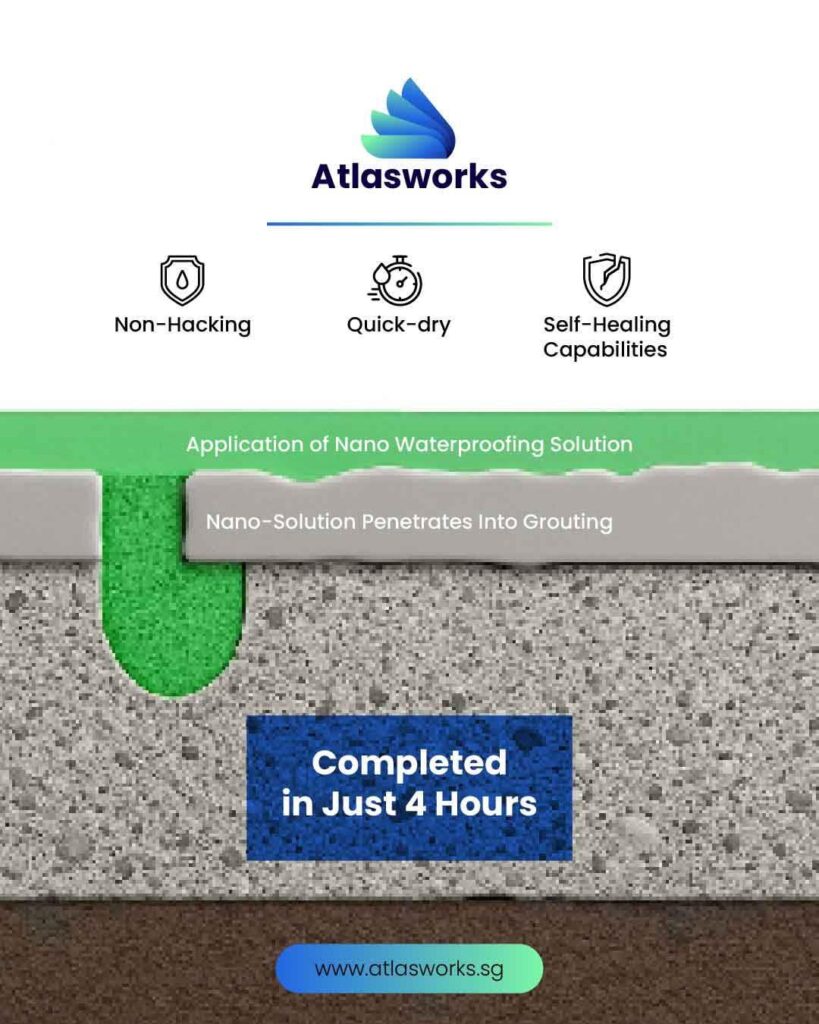
At Atlas Works, we use Canadian-engineered nano waterproofing technology that penetrates several millimetres into the core of walls, floors, and concrete surfaces — rather than forming a film on top.
How the Self-Healing Membrane Works
Unlike traditional waterproofing membranes that typically last 7–10 years, this membrane is designed with a self-healing mechanism: when water contacts a worn or damaged section, the membrane shifts into a semi-solid state, auto-seals the crack, and levels itself to restore the barrier. In plain terms — small wear and tear repairs itself, instead of turning into a leak.
No-Hacking Application Means No Business Disruption
For commercial properties, this matters more than it might seem. We apply our waterproofing solution directly to the surface—no breaking tiles, no drilling, no hacking and no loud demolition noise. By skipping the tedious hacking and re-tiling process, we wrap up work in hours rather than days, keeping your operations running smoothly.
What to Look For in a Commercial Waterproofing Contractor
Before engaging a contractor for a commercial job, it’s worth checking for a few non-negotiables:
- BCA-trained specialists — confirms the team has been trained to recognised construction industry standards
- BizSAFE certification — a Singapore workplace safety accreditation that matters for any commercial site with contractor access requirements
- A proper on-site survey before quotation — reputable contractors assess the site before pricing, rather than quoting blind
- Clear warranty terms — ask exactly what’s covered, and for how long
- Transparent, itemised quotations — costs should reflect surface type, size, labour, and materials, with no hidden fees buried in the fine print
- A documented process — moisture testing, surface prep, application, and a completion report
The Commercial Waterproofing Process
A properly run commercial waterproofing job typically follows these steps:
- On-site survey and moisture testing — checking wall or floor dampness with a moisture meter to identify the source and extent of the problem
- Surface cleaning and preparation — clearing the full surface area before any product is applied
- Application of the waterproofing solution — applied evenly across the treated surface
- Gap and joint patching — any gaps wider than 2mm are patched separately
- Curing time — typically a minimum of several hours before the surface can be used again
- Final inspection and report — documenting the completed work for your records
How Much Does Commercial Waterproofing Cost in Singapore?
There’s no honest way to give a flat price without seeing the site first — and any contractor who quotes without an inspection is guessing. Cost depends on:
- Whether it’s interior or exterior waterproofing
- The type of waterproofing solution required
- The size of the area being treated
- Skilled labour and access requirements
- Time needed to complete the project
At Atlas Works, we conduct a free on-site survey before proposing a fair, itemised quotation — and we don’t charge GST on top. Additional charges only apply for extra repair work or add-on requests identified during the survey.
Why Singapore Businesses Choose Atlas Works for Commercial Waterproofing
We’re a BCA-registered, BizSAFE Level 3 certified waterproofing contractor based in Singapore, and a Sime Darby approved vendor. Our commercial waterproofing work has been trusted by organisations including NEA, PUB, LTA, JTC, HDB, CBRE, Savills, Mapletree, CapitaLand, Ascott, Iron Mountain, GSK, Unilever, BMW, and Marina Bay Sands, among others.
What that means in practice:
- We back our commercial waterproofing work with a 3-year warranty
- Our no-hacking nano technology minimises disruption to your operations
- We conduct a proper on-site inspection before every quotation — no guesswork pricing
- Our team is BCA-trained and works to workplace safety standards suited for commercial and industrial sites
Frequently Asked Questions
How much does commercial waterproofing cost in Singapore?
It depends on the surface type, size, and whether interior or exterior work is needed. We always conduct a free on-site survey before quoting, and we don’t charge GST on top of the quoted price.
How long does commercial waterproofing take?
Because our nano waterproofing solution requires no hacking, we complete most jobs significantly faster than traditional methods. Standard areas take less than a day, plus standard curing time before you can resume full use.
Will waterproofing work disrupt our business operations?
Minimally. Our no-hacking process skips the drilling, hammering, and noisy demolition entirely. Plus, we work around your business hours so you experience zero operational downtime.
Is nano waterproofing suitable for large commercial properties?
Yes. It’s applicable across surfaces including concrete, tiles, and metal, and scales to rooftops, carparks, basements, and industrial kitchens.
What warranty do you offer on commercial waterproofing work?
We provide a 3-year warranty on our commercial waterproofing packages.
Do you handle both new waterproofing and leak repairs?
Yes — we handle new waterproofing installations as well as diagnosing and repairing existing leaks, seepage, and water damage.
Get a Free Site Survey
If water is already finding its way into your property, or you’d rather deal with it before it becomes a problem, the first step is always the same: get a proper on-site assessment. WhatsApp Atlas Works at +65 8800 0567 or email at***@********ks.sg to arrange a free commercial waterproofing survey.
